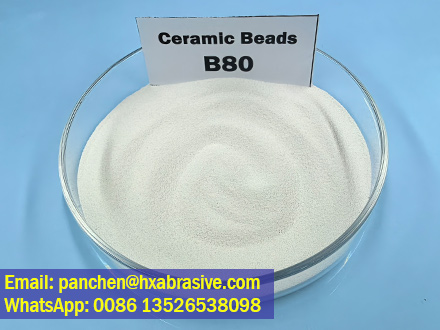
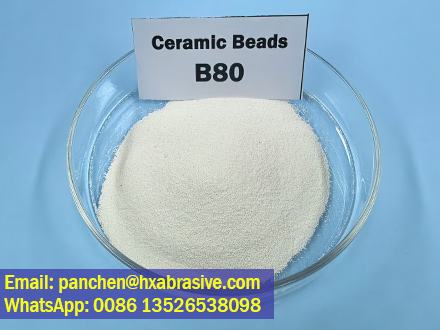
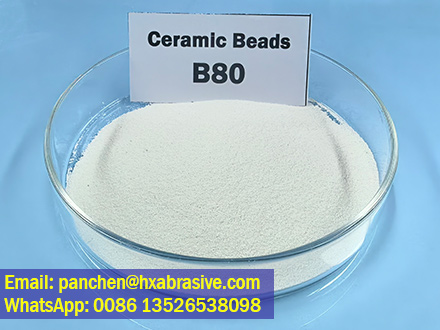
Sandblasting beads Ceramic sand B80 0.18-0.25mm
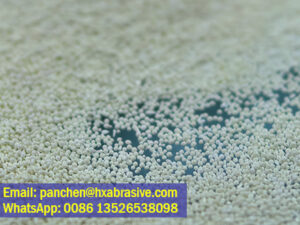
Ceramic sand B80, sandblasting beads with a particle size of 0.18-0.25mm, features high roundness and excellent wear resistance, delivers consistent matte surface effect with low dust generation, and is suitable for blasting and surface finishing of aluminum, stainless steel and die castings, boasting longer service life than ordinary glass beads.
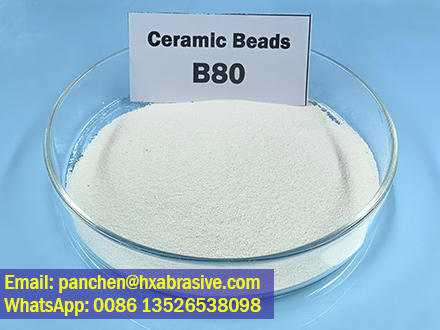
Characteristics of Sandblasting beads Ceramic sand B80 0.18-0.25mm:
- High strength and wear resistance. The main component of ceramic shot is zirconia, which is characterized by small crystal size and high wear resistance.
- The ceramic shot has high hardness, with Vickers hardness (microhardness) of 700hv and Rockwell hardness of 600 HRC. The density and specific gravity are also much higher than those of glass beads.
- No dust, high abrasion resistance, and strength make it difficult for a ceramic shot to be broken during sandblasting, so it is not easy to generate dust.
- Sandblasting effect: the surface finish is high. Using ceramic shot sandblasting can achieve smooth satin surface brightness. Using ceramic shot of the same specification is 60-70% lower than that of glass bead sandblasting.
- It is applicable to various metals and nonmetals, such as titanium alloy, magnesium alloy, aluminum alloy, stainless steel, carbon steel, brass and alloy, acrylic, plastic and other materials. The ceramic shot will not react or oxidize with metal, and there is no metal residue, so it will not affect the color of the workpiece.
- It is suitable for dry blasting and wet blasting. The surface of ceramic shot is very smooth, and the wear of sandblasting equipment is very small.
- Ceramic shot has high sandblasting efficiency and long service life, and its recycling times can reach 25 times of glass beads.
- The roundness is high, and the proportion of abnormal balls and snowman balls adhered between the spheres is low.
Chemical composition of Sandblasting beads Ceramic sand B80 0.18-0.25mm:
| Item | Standard Value | Measured Value |
| ZrO2+Y2O3 | 60-70 | 65.13 |
| SiO2 | 28-33 | 28.65 |
| Al2O3 | Max.10 | 6.80 |
| Fe2O3 | Max.0.06 | 0.02 |
| TiO2 | Max.0.20 | 0.15 |
Physical features of Sandblasting beads Ceramic sand B80 0.18-0.25mm:
| Item | Standard Value | Measured Value |
| Particle Size | +60#(0.250mm) <5% +80#(0.180mm) – +100#(0.150mm) – +120#(0.125mm) – -120#(0.125mm) <5% | 0% 50.6% 39.64% 8.46% 1.3% |
| Specific Gravity | Min. 3.85 g/cm3 | 3.85 g/cm3 |
| Bulk Density | Min. 2.30 g/cm3 | 2.35 g/cm3 |
| Vickers Hardness | Min. 700 HV | 745 HV |
Specification:
| Specification | Particle Range | Diameter | Sieve Retained Ratio |
| B20 | 0.600-0.850 mm | >0.85mm | <5% |
| 0.6-0.85 mm | >90% | ||
| <0.6 mm | <5% | ||
| B30 | 0.425-0.600 mm | >0.6 mm | <5% |
| 0.425-0.60 mm | >90% | ||
| <0.425 mm | <5% | ||
| B40 | 0.250-0.425 mm | 0.425-0.500 mm | <5% |
| 0.250-0.425 mm | >90% | ||
| <0.250 mm | <5% | ||
| B60 | 0.125-0.250 mm | 0.250-0.300 mm | <5% |
| 0.125-0.250 mm | >90% | ||
| <0.125 mm | <5% | ||
| CB60 | 0.125-0.250 mm | 0.250-0.300 mm | <5% |
| 0.180-0.250 mm | 40-55% | ||
| 0.125-0.180 mm | 35-55% | ||
| 0.106-0.125 mm | <8% | ||
| <0.106 mm | <5% | ||
| CB60+ | 0.125-0.250 mm | 0.250-0.300 mm | <5% |
| 0.180-0.250 mm | 65-75% | ||
| 0.125-0.180 mm | 25-35% | ||
| 0.106-0.125 mm | <5% | ||
| <0.106 mm | <2% | ||
| B80 | 0.180-0.250 mm | 0.250-0.300 mm | <10% |
| 0.180-0.250 mm | 85-100% | ||
| 0.125-0.180 mm | <10% | ||
| B100 | 0.125-0.180 mm | >0.180 mm | <10% |
| 0.125-0.180 mm | >80% | ||
| <0.125 mm | <10% | ||
| B120 | 0.063-0.150 mm | 0.150-0.212 mm | <3% |
| 0.125-0.150 mm | 35-45% | ||
| 0.063-0.125 mm | 55-65% | ||
| <0.063mm | <5% | ||
| NB120 | 0.063-0.125 mm | >0.212 mm | <3% |
| 0.125-0.212 mm | <10% | ||
| 0.063-0.125 mm | >80% | ||
| <0.063 mm | <10% | ||
| FB120 | 0.125-0.150 mm | >0.150 mm | <5% |
| 0.125-0.150 mm | >90% | ||
| <0.090 mm | <5% | ||
| B125 | 0-0.125 mm | >0.125 mm | <5% |
| B150 | 0.063-0.150 mm | >0.150 mm | <5% |
| <0.063 mm | <5% | ||
| B170 | 0.045-0.150 mm | >0.150 mm | <5% |
| 0.045-0.150 mm | >90% | ||
| <0.0.045 mm | <5% | ||
| B170+ | 0.090-0.106 mm | >0.106 mm | <5% |
| 0.090-0.106 mm | 40-65% | ||
| 0.063-0.090 mm | 20-50% | ||
| <0.063 mm | <10% | ||
| BZ170 | 0.045-0.090 mm | >0.090 mm | <5% |
| 0.063-0.090 mm | 70-85% | ||
| 0.045-0.063 mm | 10-30% | ||
| <0.045 mm | <7% | ||
| BY170 | 0.045-0.090 mm | >0.090 mm | <5% |
| 0.045-0.090 mm | >85% | ||
| <0.045 mm | <10% | ||
| WB170 | 0-0.090 mm | >0.090 mm | <5% |
| B205 | 0-0.063 mm | >0.063 mm | <5% |
| B400 | 0.030-0.063 mm | >0.063 mm | <5% |
| <0.053 mm | <30% | ||
| B505 | 0.010-0.030 mm | >0.053 mm | <5% |
*Other customized sizes are available.
Applications of Ceramic sand B80:
- Medical treatment. It works for surface treatment such as deburring of stainless steel surgical instruments and titanium alloy human implanted devices.
- High iron field: it can be used for sandblasting the surface of high iron aluminum alloy parts to improve the metal texture and form a smooth satin effect. Used for grinding and finishing of high-speed rail.
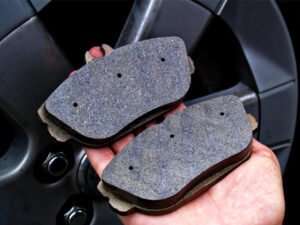
- Automotive field: ceramic shot can be used for surface cleaning and deburring of Automotive Engine Castings; It is used to clean the welds and welding spots on the car floor and prepare for subsequent spraying; Used for shot peening of automobile springs to improve fatigue life. It is used for beautification and sandblasting of aluminum alloy automobile wheels to eliminate stress and improve impact resistance.
- Mold and machining: used for sandblasting of stainless steel mold, copper mold and aluminum alloy mold, such as tire mold, injection mold and stamping mold, to improve surface finish. Clean the flash and burr of machined parts.
- Electronic equipment field: the ceramic shot is used for sandblasting the shells of mobile phones, tablet computers and watches made of aluminum alloy or stainless steel. It can adjust the roughness and gloss of the surface as required, and has the characteristics of anti-fingerprint.
- Kitchen utensils industry: it is used for sandblasting of high-quality stainless steel cookware, pot bottom, soup spoon and other products, giving the products delicate metal texture and certain antibacterial ability.
- Glass products industry: used for atomization treatment of glass, replacing hydrofluoric acid chemical etching process to prevent pollution.
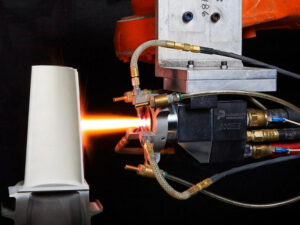
- Shot peening of aviation parts: used to improve the fatigue resistance of carbon steel, titanium alloy, aluminum alloy and other aviation mechanical parts and eliminate surface stress. Moreover, it can be used for surface strengthening of aircraft wings, aeroengine turbine blades, turbine discs, gears and landing gear.


Ceramic sand B80 Package:
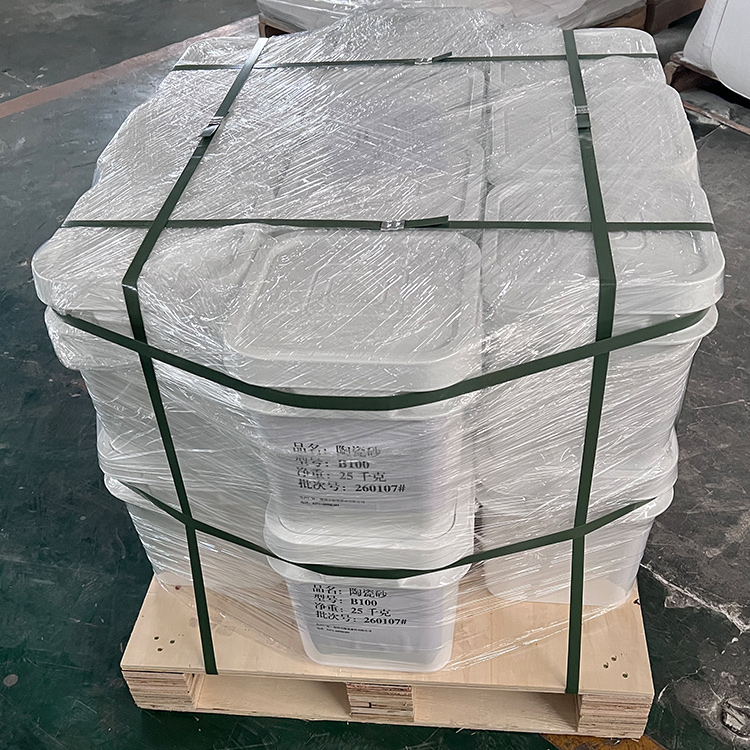
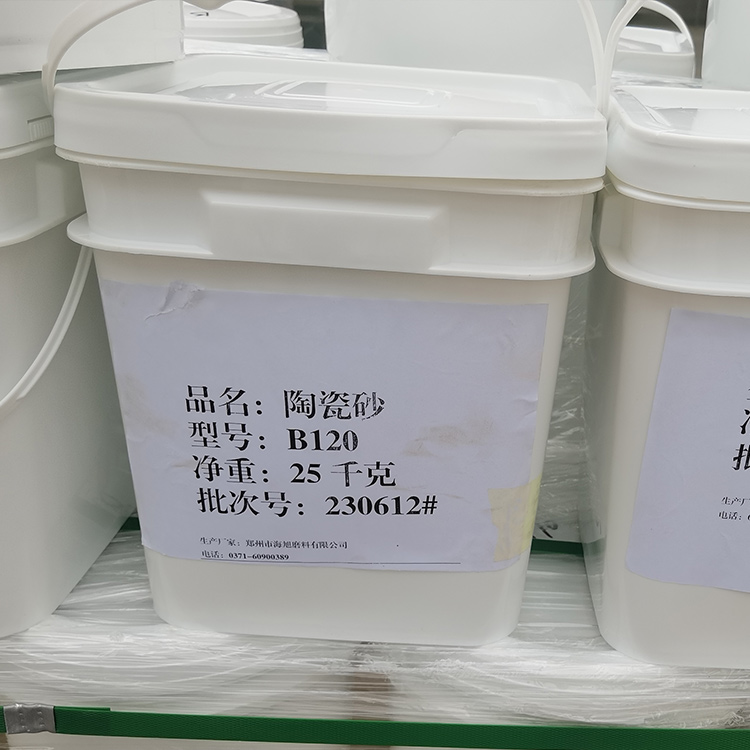
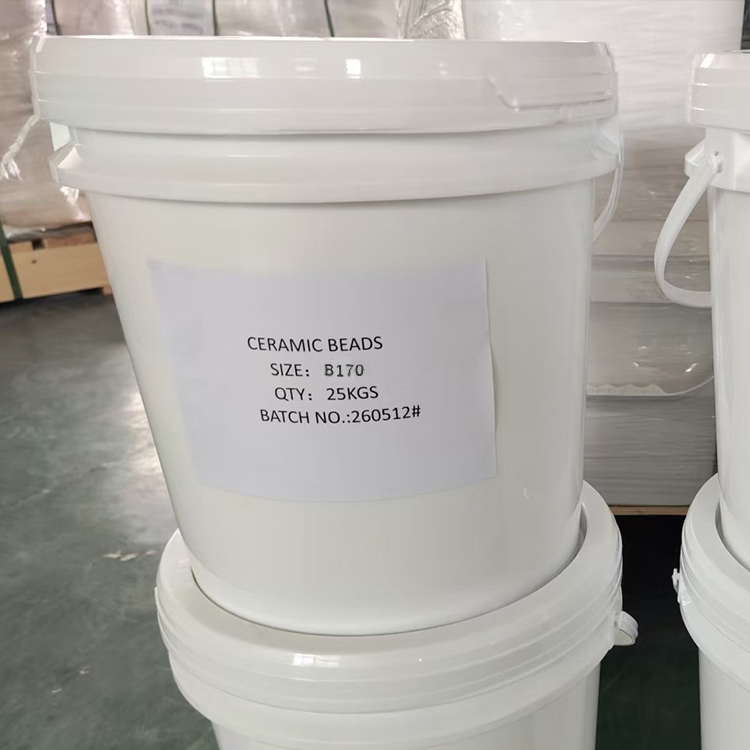
Granalla cerámica,Abrasivo cerámico,Microesferas de cerámica,Microesferas de cerámica B80, Microesferas de cerámica B40,Microesferas de cerámica B205,Perla
FAQ:
1. Q: Are ceramic sand, ceramic beads, zirconium sand, and zirconium silicate sand the same product?
A: Almoste all kinds of Zirconium based material are from zircon sand but undergo different processing and purification methods. The primary mineral component of zircon sand is zirconium silicate, with a chemical composition consisting mainly of 60–70% zirconium dioxide. In the sandblasting industry, the terms “ceramic sand,” “ceramic beads,” “zirconium sand,” and “zirconium silicate sand” refer to the same product—zircon sand that has been processed via electric fusion.
2. Q: Can ceramic beads replace glass beads?
A: In terms of sandblasting results, ceramic beads can effectively replace glass beads, offering the added advantages of higher efficiency and a longer, multi-use lifespan. However, ceramic sand requires a higher initial investment, making it better suited for the sandblasting of high-end workpieces.
3. Q: What raw material is used to produce ceramic blasting media?
A: Ceramic blasting media is produced from zircon sand through high-temperature electric fusion. Haixu Abrasives, a professional manufacturer of ceramic media, utilizes Australian zircon sand with a 66% zirconium dioxide content, resulting in a product with high strength and excellent durability.
4. Q: How should the particle size of zirconium-based blasting media be selected?
A: The selection should be based on the desired surface roughness of the metal. Finer particles result in a smoother surface finish and lower surface roughness.
5. Q: Can ceramic sand be exported?
A: Although ceramic sand contains zirconium dioxide, the zirconium cannot be extracted from it as a separate substance. Therefore, ceramic sand is eligible for export.
6. Q: Is your company a manufacturer of ceramic beads blasting media?
A: Yes, we are a manufacturer of ceramic beads , specifically our “B” series Ceramic shot blasting media and “Z” series ceramic beads Shot peening media.